
Over the past decades, the legalization of samesex unions and more liberal attitudes toward sexual minorities have contributed to an increase in same-sex couples raising children. Yet becoming a parent is still far from straightforward for many sexual minorities. Unlike heterosexual couples, same-sex couples usually cannot have children without external help. Many must rely on fertility treatments, adoption, or co-parenting arrangements. These processes are often expensive, legally complex, and emotionally demanding. These challenges are especially strong for male same-sex couples, who more often depend on highly regulated and socially contested routes such as surrogacy or adoption.
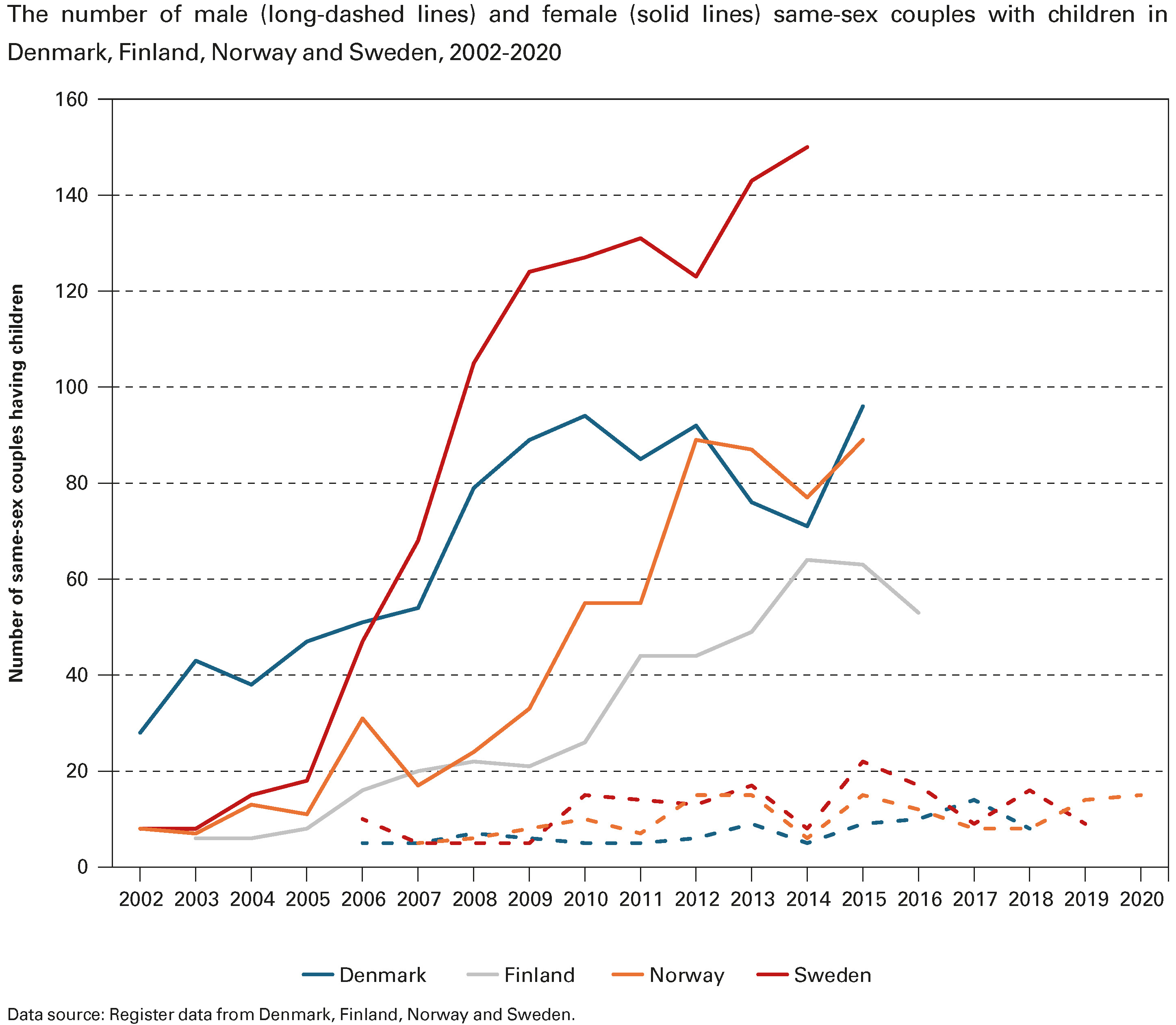
The figure below illustrates this using register data from Denmark, Finland, Norway and Sweden. It shows that the number of female same-sex couples with children has increased over time, with visible rises following the opening of fertility clinics to lesbian couples in Sweden (2005) and Denmark (2007). At the same time, the absolute numbers remain limited: the figure only includes couples who became parents, meaning that parenthood among female couples remains relatively uncommon. For male same-sex couples, the numbers remain very small, with little or no growth over time. In Finland, there were too few male couples with children to include in the figure at all.
The rarity and challenges of parenthood among same-sex couples raise a fundamental question: who is able to become a parent and under what conditions? A new project will address this by comparing same-sex couples who do and do not become parents. This makes it possible to examine, for example, whether access to parenthood depends on having sufficient financial resources, since for many same-sex couples becoming a parent involves long and costly routes. We can also explore the role of legal conditions, such as whether couples have access to fertility clinics or surrogacy. These patterns will be examined using population register data from the Netherlands, Denmark, Finland, Norway and Sweden.
Next, the project focuses more on the personal pathways to parenthood by examining who wants to have children, and what happens when people try to make that wish a reality. A new nationally representative survey will follow sexual minorities over time to study how desires to have children turn into intentions, attempts, and eventually parenthood—or why they sometimes do not. This includes questions about experiences of discrimination along the road to parenthood and the role of support—or lack of support—from family, friends, and institutions.
These insights are relevant for researchers studying contemporary family formation and for policymakers aiming to reduce inequalities in access to parenthood, especially amid growing backlash against LGBTQ+ rights.
The Queer Pathways to Parenthood (QPATHS) project is funded by an ERC starting grant (2026-2031).
Maaike van der Vleuten, NIDI-KNAW / University of Groningen, e-mail: Vleuten@nidi.nl
References
- Evertsson, M., Y. Moberg and M. van der Vleuten (2025), Stimulating (in)equality? The earnings penalty in different-sex and female same-sex couples transitioning to parenthood in Denmark, Finland, Norway, and Sweden. American Journal of Sociology, 130 (6), pp. 1477-1525.
- Van der Vleuten, M., Y. Moberg and E. Evertsson (2025), Parental leave patterns among fathers in male same-sex couples in Denmark, Norway and Sweden, working paper. Registered-Based Fertility Group, Antwerp, Belgium.
