
Over the past few decades, fertility rates in developed countries have dropped significantly. In countries that are part of the Organisation for Economic Co-operation and Development (OECD), the average number of children per woman fell from 1.70 in 2000 to 1.43 in 2023. At the same time, more people are remaining childless. In some countries, more than one in five adults will never have children at all. These changes are often linked to structural factors such as the rising cost of housing, job insecurity, and the challenges of balancing work and family life. However, these practical barriers are only part of the story. People’s attitudes toward parenthood itself also appear to be changing.
To better understand how people think about having children, we used data from the GGS, a large international study on family life, relationships, and personal values. The aim was to explore how people weigh the potential benefits and drawbacks of becoming a parent.
The role of motivations in fertility decisions
Deciding whether or not to have children is complex. People must consider their financial situation, housing, career plans, personal values, and social expectations. According to psychologist Warren Miller, this decision is shaped by “childbearing motivations” that develop early in life and are influenced by upbringing, culture, and personal experiences. Over time, these childbearing motivations shape both what people want and what they plan to do. A key idea in this theory is the difference between positive and negative motivations. Positive motivations include the expected rewards of parenthood, such as emotional fulfillment and a sense of purpose. Negative motivations focus on challenges like financial strain, reduced freedom, career difficulties, and stress. People are more likely to have children when the perceived benefits outweigh the costs and when their circumstances allow it. When concerns are stronger, they may delay or avoid parenthood.
Measuring motivations
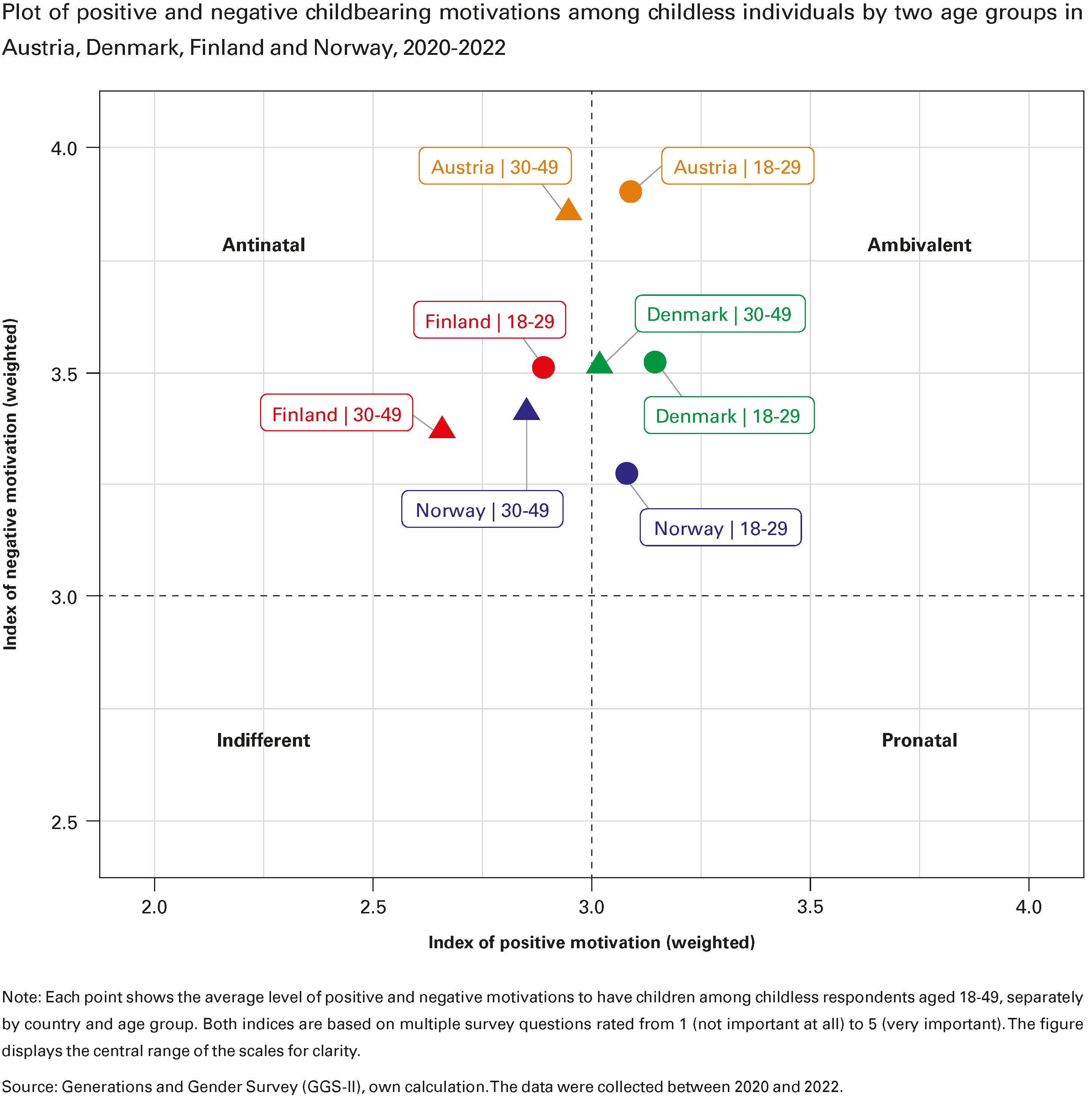
The survey data used in this study are particularly valuable because the surveys directly measure both types of motivation. In four countries (Austria, Denmark, Finland, and Norway) survey participants in the GGS-II answered a set of questions designed to capture how strongly they felt about the benefits and drawbacks of parenthood. These responses were combined into two scales: one for positive motivation and one for negative motivation. By comparing the two, we could group people into four broad categories: those who are clearly in favour of having children (pro-natal), those who are clearly against it (anti-natal), those who feel indifferent, and those who have mixed feelings (ambivalent).
Young adults are ambivalent about parenthood
The results reveal a striking pattern. While ‘older’ childless adults (aged 30–49) predominantly fall into the ‘anti-natal’ category, the younger groups (aged 18–29) lean more toward the ‘ambivalent’ one. This means the younger adults recognise some of the positive aspects of parenthood, but their concerns are slightly stronger. In other words, it is not that young people do not see any value in having children – they do – but their worries tend to outweigh the perceived benefits.
This finding challenges a common assumption that low fertility rates are mainly driven by structural obstacles that prevent people from having the children that they would want to have. Instead, it suggests that many people are hesitant. They may like the idea of having a family, but feel held back by practical or emotional concerns. This ongoing tension can lead to the postponement of childbearing, and in some cases, to remaining childless altogether.
While the overall pattern is similar across countries, there are some differences. For example, in Finland, both very young and young adults appear to lean more toward negative motivations than positive ones. This places them closer to the “anti-natalist” category, where concerns clearly outweigh perceived benefits. Although the reasons for this are not yet fully understood, it may help explain why Finland currently has one of the lowest fertility rates in Europe.
Taken together, these findings point to a broader cultural shift. Parenthood is no longer seen as an obvious or automatic life step for many people. Instead, it is a choice that comes with both appealing and challenging aspects. As long as concerns about cost, stress, and lifestyle changes remain strong, and as long as these concerns outweigh the perceived rewards, fertility rates are likely to stay low.
Anne Gauthier, NIDI-KNAW / University of Groningen, e-mail: gauthier@nidi.nl
Monika Mynarska, Cardinal Stefan Wyszyński University in Warsaw, e-mail: m.mynarska@uksw.edu.pl
Nursel Alkoç, NIDI-KNAW / University of Groningen, e-mail: alkoc@nidi.nl
References
- Gauthier, A.H., S. Kong, O. Grünwald, M. Bujard, A. Caporali, V.J. Deimantas, T. Emery, W. Jablonski, J.C. Koops, A. Rijken and A. Schumann (2025), The Generations and Gender Survey: a cross-national longitudinal resource, European Sociological Review, 41(6), pp. 983–1001.
- Mynarska, M. and J. Rytel (2023), Childbearing motivation at the onset of emerging adulthood. Journal of Youth Studies, 26(9), pp. 1163–1181.
