
Many rural regions across Europe are suffering from depopulation. This is particularly true of ‘left behind’ regions, which also suffer from low regional development. This depopulation has multiple causes. Firstly, these regions experience net outwards migration – people leave in search of higher standards of living and expanded economic opportunities. This effect is particularly strong for the young and highly educated. Secondly, rural regions often have older populations resulting in few births and many deaths, which also decreases the total population.
This depopulation affects regions in several ways. Because younger people are more likely to leave, the average age in these regions increases. The resulting ‘ageing’ population is unbalanced with many retirees and few working age adults. This reduces the region’s tax income and places a high burden on health and social care. Also, these regions suffer from a so-called ‘brain drain’ because the young and talented tend to leave. This further hampers innovation and economic development, making the region even less attractive, resulting in a vicious cycle.
To examine the above stated effects we conducted a case study in Norway by making use of data from the Norwegian population register. We assess Norwegian regions by three scores: (1) an economic score, based on e.g. employment rates and innovation scores; (2) a social score, using indicators as crime rates and life satisfaction; and (3) a living environment score, with indicators such as air pollution and number of hospitals. These three scores are then analysed in combination with data from the Norwegian population register on which regions people have moved to and from. This analysis reveals moving priorities for people with different characteristics like age, gender and education, and these priorities sum to 100 percent. For example, a person that cares mostly about economic development when assessing if a region is attractive or not, but is less concerned with social development and even less with living environment may have an economic priority of 70 percent a social priority of 20 percent, and a living environment priority of 10 percent.
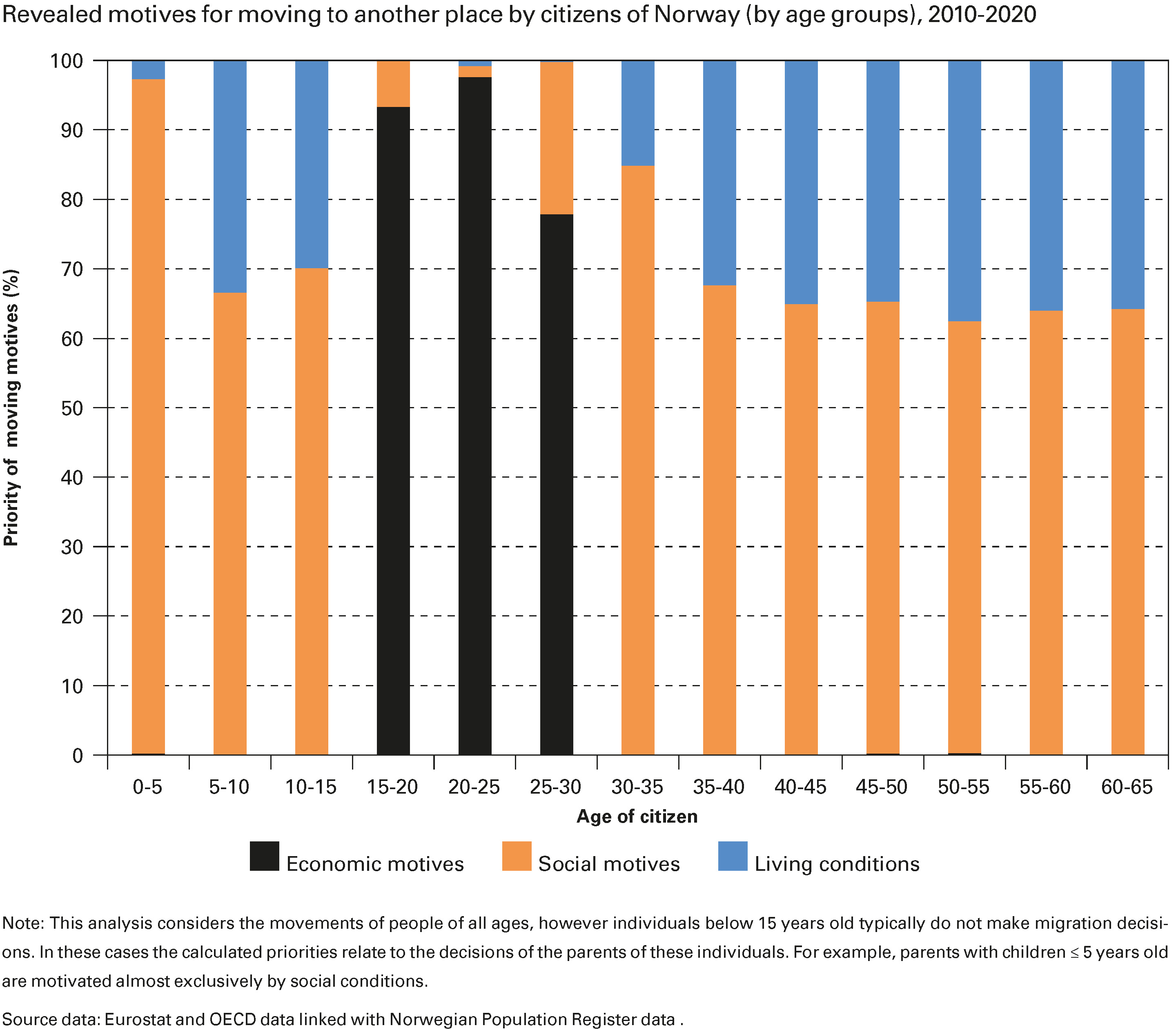
The figure on the right shows how on average people’s priorities change with age. Unsurprisingly, economic priorities dominate among young adults (age 20-30), however, once people have typically established careers and are looking to settle down, the social dimension dominates. The living environment dimension is also relatively highly prioritised at ages 30 and older, but social concerns dominate.
This is good news for left behind regions. They may never be able to compete with cities like Oslo or Bergen in terms of economic performance, but by concentrating on policies which improve social and living conditions they can compete for working age adults from their early 30s. Attracting such people to the region reduces depopulation, brain drain, and population ageing.
Becky Arnold, NIDI-KNAW / University of Groningen, email: arnold@nidi.nl
Leo van Wissen, NIDI-KNAW / University of Groningen, email: wissen@nidi.nl
References
- Newsham, N. and F. Rowe (2025), The demographic causes of European sub-national population declines. European Journal of Population, 41, 10, pp. 1-38.
