
The Netherlands is known for its early tracking educational system. Around age 12, children take a standardized test that plays a decisive role in determining their secondary-school track. Small differences in performance at this stage can have long-lasting consequences for educational careers, and children with a migration background often underperform at this key exam, particularly in the language domain. For children growing up in immigrant families, exposure to Dutch at home varies widely. Some parents mostly speak their language of origin, others use Dutch regularly, and many combine both. But how much does home exposure to the instruction language actually matter for immigrant children’s school careers?
By linking harmonized immigrant surveys, school administrative data, and population registers from Statistics Netherlands (for details, see sources below the figure), we examine how home language environment during primary school years relates to children’s education. The surveys include information on how often parents speak Dutch with their children. We combine these data with children’s standardized test scores at the end of primary school and subsequent enrollment in higher education. We present findings for more than three thousand children with a migrant background who completed primary school between 2006 and 2017.
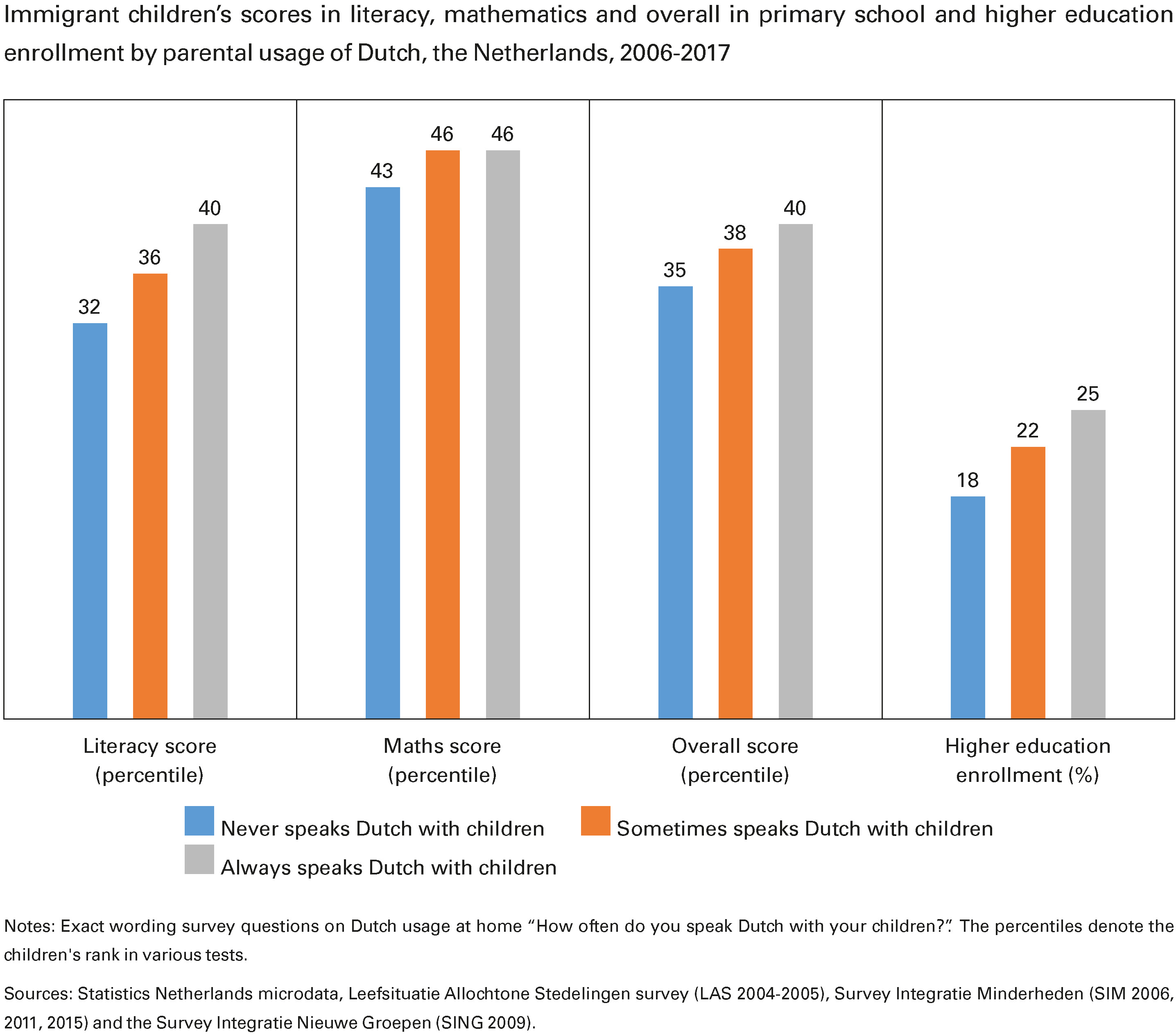
The figure reports the differences in children’s test performance (as score percentiles) and higher education enrollment (in percentage points) across different language exposure frequencies at home. Children whose surveyed parent never speaks in Dutch to them fare worse in literacy tests, barely ranking above the 30th percentile; children regularly communicating in Dutch with parents reach the 40th percentile on average. The overall exit scores mainly reflect the literacy-related rankings, since mathematics scores are generally unaffected by language exposure.
Does this early gap persist? We find that those who grew up with more Dutch at home are indeed more likely to be enrolled in higher education, either vocational or academic. Only 18 percent of children with non-Dutch speaking parents during their childhood managed to access higher education of some form by the age of 18, in contrast to 25 percent of their peers with frequent Dutch-speaking parents.
These findings have broader relevance for countries with early tracking education systems, such as Germany, Austria and Belgium. In such systems, unequal opportunities to be exposed to the language of instruction at home before the moment of tracking can shape educational pathways and, ultimately, later life chances. Our results suggest that there may be value in initiatives that support immigrant parents in using the destination language with their children, or that encourage bilingual practices within families. This does not imply abandoning heritage languages; rather, it highlights the importance of ensuring that the language of schooling is part of everyday family life.
Stefano Cellini, NIDI-KNAW / University of Groningen, e-mail: cellini@nidi.nl
