
For decades, there have been reports in the national media warning that the ageing concert audience poses a potential threat to the survival of classical music. These pessimistic reports are counterbalanced by optimistic voices that view ageing against the backdrop of a growing target group of healthy, active and affluent senior citizens. The driving forces behind the ageing of concert audiences, however, are rarely investigated. The ageing of concert audiences can be explained by two factors that are not mutually exclusive. The first emphasises age differences: as people get older, they have more time, financial resources and appreciation for classical music, and as a result, concert attendance increases. The second explanation emphasises generational differences: older generations grew up with classical music and were already concertgoers in their youth and continue to do so into old age, whereas younger generations have different cultural preferences, a wider range of music to choose from, and are said to show a declining interest in classical music. We have compiled a dataset on classical music concert attendance between 1979 and 2022 to investigate these two mechanisms behind the ageing trend.
Analysis of these figures showed that concert attendance in the Netherlands remained fairly constant during the period from 1979 to 2022, with approximately 15-20 per cent of respondents attending one or more concerts annually. However, the audience is undeniably ageing. Whereas at the turn of the century, the proportion of older people in concert halls was less than 25 per cent, today almost 60 per cent of the audience is aged 65 or over. Both age and generational differences are key factors in this trend. Attendance at classical music concerts increases with age and peaks around the age of 75-80; 25 per cent of this age group attends classical concerts. After the age of 80, concert attendance declines significantly. Those born between 1935 and 1954 are the most frequent visitors, with subsequent generations attending less and less often. It is worth noting that the decline across generations is levelling off somewhat.
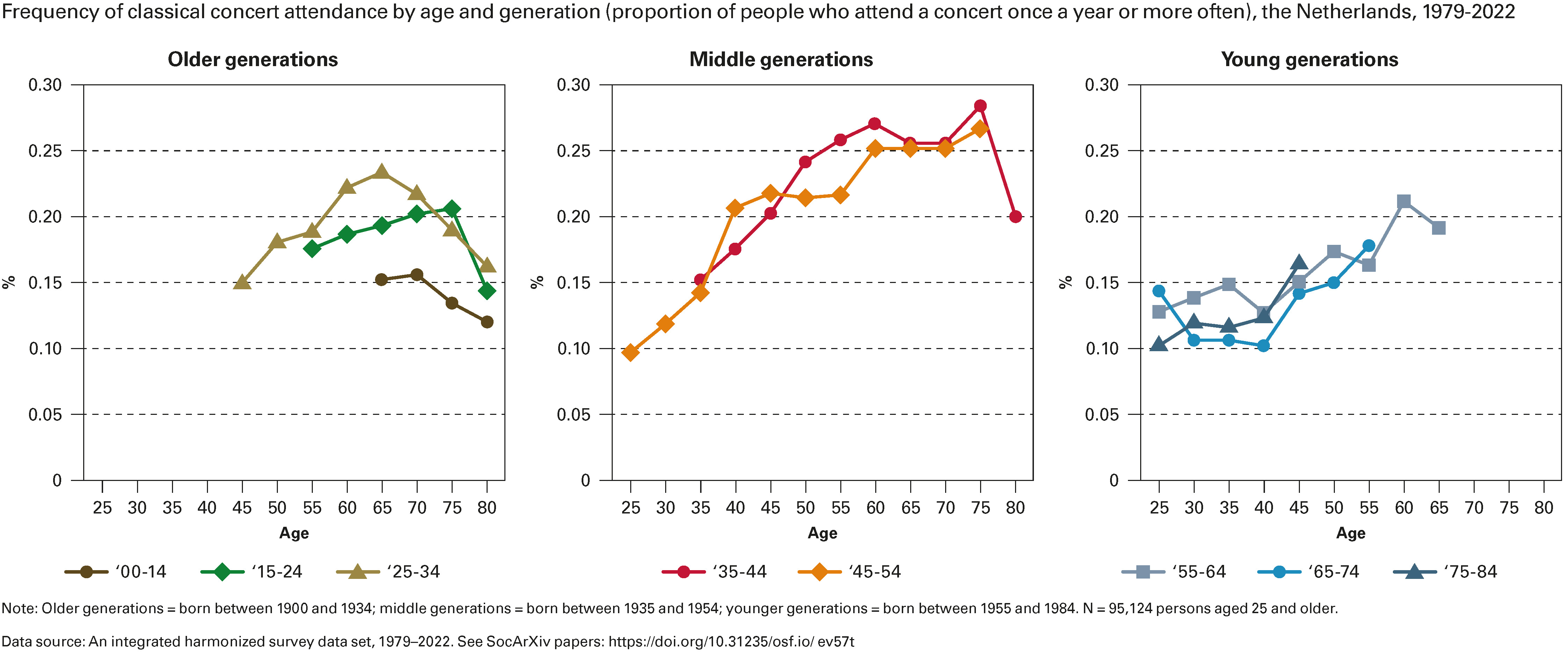
The generations also show different age profiles (see figure). The older generations show a sharp increase with age, but also a rapid and early decline: attendance begins to decline around the age of 65 among the cohorts born between 1925 and 1934. For middle generations, the decline begins much later, after the age of 75-80, which clearly illustrates the rise of more active older people. The youngest generations, on the other hand, show a flatter pattern of increase with age, but these generations are still too young to see whether their participation will continue to increase into old age, as we saw with the generations that preceded them.
Matthijs Kalmijn, NIDI-KNAW / University of Groningen, e-mail: kalmijn@nidi.nl
Kène Henkens, NIDI-KNAW / University of Groningen, UMCG, e-mail: henkens@nidi.nl
References
- Kalmijn, M. and K. Henkens (2025), Het publiek vergrijst maar het klassieke concert blijft. Economisch Statistische Berichten, 109(4837), pp. 416-419.
