
Childbirth has traditionally served as a turning point in women’s professional careers. Women’s reduced involvement in paid work after childbirth has far-reaching consequences for their lifelong financial position and independence. After time away from work, returning can be difficult and the missed experience limits career development. This increases the risk of later periods of nonemployment. Women’s improved labour market positions in most EU countries could pave the way for a more equal division of parental roles, potentially limiting women’s reduced or nonemployment after childbirth. However, the extent to which this is the case also depends on prevailing gender norms and work-family policies, which differ widely between countries. Therefore, we examine the gap in employment rates between women and men with and without children in a selection of EU countries.
That childbirth remains an important driver for gender differences in employment rates becomes clear from the figure below. The columns reflect the gaps in employment rates between women and men aged 25-54 in 2024, by number of children. Higher values reflect greater percentage- point differences in the advantage of men. In most countries, the employment gap is modest among the childless. The EU average is 4 percentage points, albeit much larger in Italy (12% pt.) and negative in Estonia (-3% pt.), where childless women work more often than their male counterparts. Among parents, the gaps are much larger, and some notable differences emerge. In Germany and Ireland, the differences among the childless are small, but considerably larger among parents. In the Netherlands, and to a lesser extent in Sweden, the gap among people without children is slightly larger, but differs less from the gap among parents.
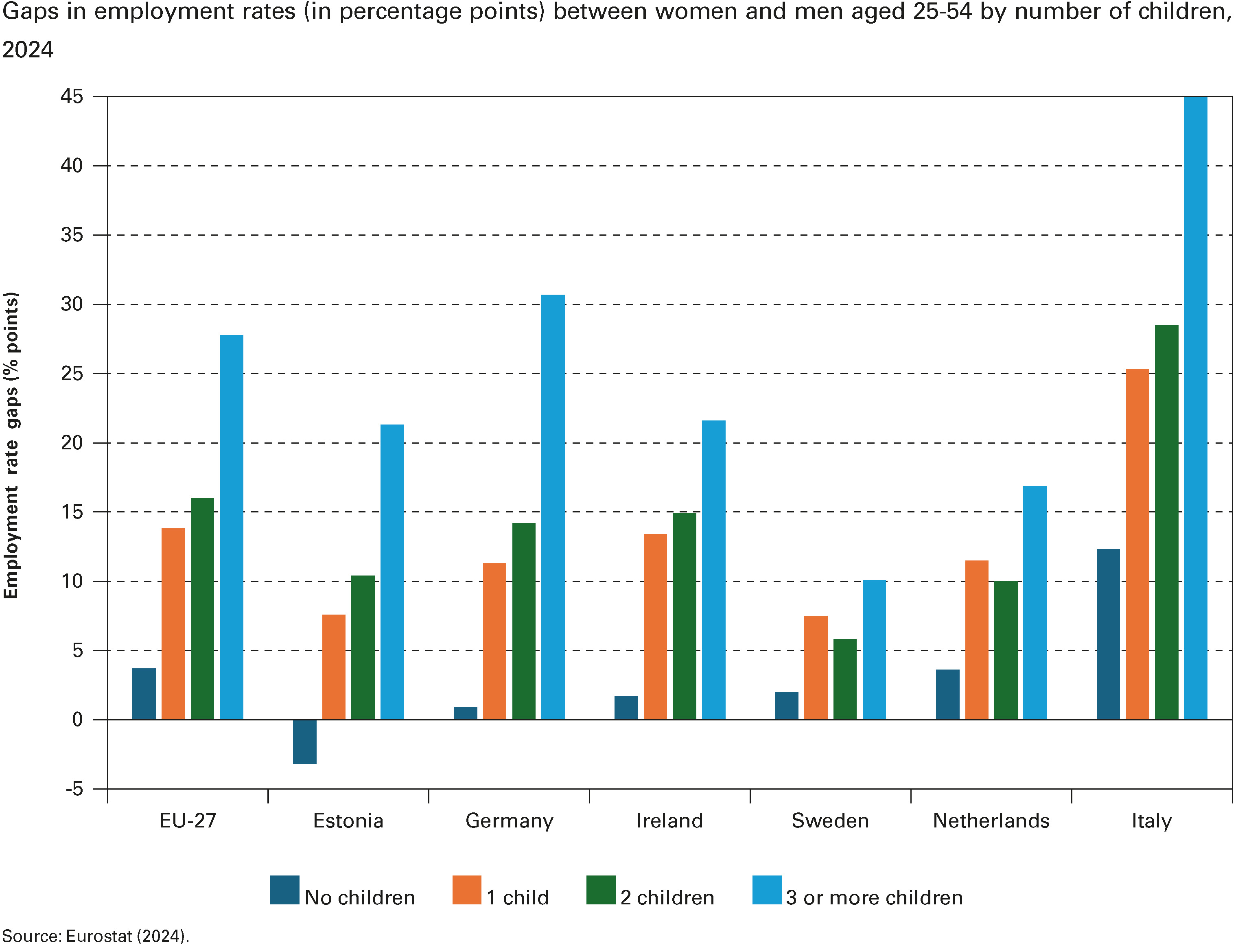
The figure suggests that most of the unpaid work associated with childcare is still done by women. Gender norms, work-family policies, and labour market circumstances may explain between-country differences. For instance, Italy remains characterised by the male breadwinner model, supporting a gendered division between care and paid work. In the Netherlands, the accessibility of part-time work has resulted in a one-and-a-half earner model. This facilitates the combination of childrearing and paid work, but still comes with long-term career trade-offs as mothers work fewer hours. Sweden has extensive and comparatively gender-equal parental leave and childcare policies, facilitating a dual earner/dual carer model. Still, even there, a substantial employment gap after childbirth remains. Previous research suggests that although gender norms in general have become more egalitarian, becoming a parent re-instates more traditional behaviour among mothers and fathers. As a result, despite growing gender equality in labour markets, childbirth remains a major source of differences in women’s and men’s employment, even in favourable contexts.
Jasper Bosma, NIDI-KNAW / University of Groningen, e-mail: bosma@nidi.nl
Julia Rokos, NIDI-KNAW / University of Groningen, e-mail: rokos@nidi.nl
Rosa Glijn, NIDI-KNAW / University of Groningen, e-mail: glijn@nidi.nl
